
Sakana Fugaku Review: Why AI Teams Beat Single Models
 admin
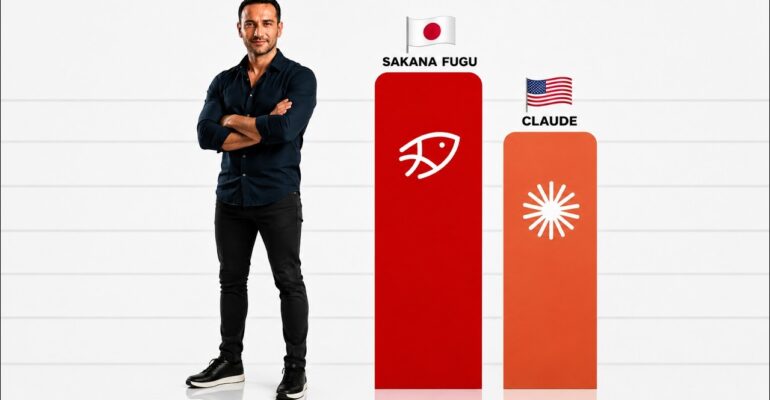
admin Remember Fabio 5? The world’s most powerful AI that got shut down overnight by a government decision? It’s still offline. Everyone’s been wondering how we’d ever reach that level again. Today, an answer came from Japan. Sakana, a Japanese company, released something called Fugaku, and their claim sounds almost impossible: performance on par with that legendary shut-down model—except no government can ever close it. Why? Because it’s not one model. Let me explain how this works and why it could change everything about where AI is heading.
Key Takeaways
- Fugaku uses a “team of experts” approach—multiple top AI models working together through a coordinator, rather than one giant model
- Fugaku Ultra scored 73.7 on industry benchmarks, beating GPT-4.8 (58), Gemini 3.1 Pro (54), and Opus 4.8 (69)
- Solved a Rubik’s cube in 19 steps, fewer than GPT, Gemini, and Claude
- If one model gets restricted or shut down, Fugaku automatically routes to alternatives—you never notice
- Two versions: standard Fugaku for daily tasks, Fugaku Ultra for complex multi-step work
- Pricing ranges from $20/month (standard) to $200/month (maximum tier)
- Not yet available in Europe, UK, or Switzerland as of my testing
- Sakana does not claim to beat Fabio 5—only to be “shoulder to shoulder” with it
Why I Started Paying Attention to Sakana’s Approach
I’ve been watching the AI race for years, and until now, everyone was running the same race. OpenAI, Google, Anthropic, xAI, Mistral—they were all competing on the same metric: who could build the biggest model with the most data and the most compute power. Bigger brain, more power, more parameters. It was a single-genius arms race.
The Japanese team at Sakana asked a completely different question: instead of building one bigger genius, what if we gathered existing geniuses and taught them to work as a team?
That’s Fugaku. From the outside, you ask it one question. Inside, an entire team is working. Each of the world’s best models acts as a specialist in its domain. Fugaku learned on its own which task to assign to which model, when to hand off work, how to combine answers, and how to synthesize the final result. This isn’t a bunch of if-then rules—it’s a trained coordinator. Two scientific papers back this up, so this isn’t a hype claim floating in thin air.
What the Benchmark Numbers Actually Show
I always dig into the numbers before I trust any AI company’s marketing. Here’s what I found when I looked at Fugaku’s performance data:
Fugaku comes in two versions. Standard Fugaku handles daily tasks. Fugaku Ultra tackles complex, multi-step problems. The Ultra version went up against the most powerful publicly available models, and the results caught my attention.
On the key benchmark scores: Fugaku Ultra hit 73.7, while Opus 4.8 scored 69, GPT-4.8 scored 58, and Gemini 3.1 Pro scored 54. That’s a significant gap across the board.
One test that stood out to me: the Rubik’s cube solving benchmark. Fugaku Ultra solved it in 19 steps. GPT, Gemini, and Claude all needed more steps. It found the most efficient path—not by being a bigger single model, but by coordinating specialists effectively.
However, I need to be completely honest here. Sakana does not claim to surpass Fabio 5. Their own wording is “shoulder to shoulder” with it. Since Fabio 5 is shut down, no direct head-to-head testing was even possible. The comparison relies only on extrapolated scores from published benchmarks. Don’t believe videos claiming Fugaku “crushed” Fabio 5—technically, that’s impossible right now.
The Real Innovation: Why No Government Can Shut This Down
This is where Fugaku gets genuinely interesting for anyone building a business on AI. Remember why Fabio 5 mattered so much when it disappeared? One company, one model, gone overnight. Everyone dependent on it was left exposed.
Fugaku solves this structurally. Since multiple models operate inside the system, if one gets restricted, if one company’s API prices spike, if one jurisdiction bans a specific model—Fugaku automatically routes to the alternatives. You don’t notice. The system keeps running and keeps training itself.
Think about what this means: you’re no longer dependent on a single company, a single country, or a single model. This is exactly what I’ve been saying for months—don’t tether yourself to one model. Fugaku has productized that philosophy into a single interface.
Early users in code review report finding over 20 issues where other tools normally catch only 3. The multi-model depth shows up in real workflows.
The Honest Downsides I Found
I promised an honest review, so here are the three concerns that stood out to me:
1. The Hidden Orchestration Layer
Fugaku can obscure which model handles which task, what the actual costs are, and what’s happening under the hood. Transparency matters to me, and this is a genuine trade-off with their approach.
2. Pricing Can Bite
Running that many models isn’t cheap. The Ultra tier especially needs selective use. I saw input costs at $5 and output at $30 for certain operations. The standard plans run $20/month internationally, professional at $100/month, and maximum at $200/month. If you’re not careful about when you invoke Ultra, costs escalate fast.
3. The “Beats Fabio 5” Claim Is Overstated
I’ve seen this narrative spreading online. Sakana themselves don’t make this claim. The reality: Fugaku brings competitive performance to what’s publicly accessible. That’s valuable enough without exaggeration.
Availability and What I Couldn’t Test
I live in the UK, and here’s a frustrating reality: Fugaku isn’t available here yet. The same applies to Europe and Switzerland. Sakana’s site indicates these regions are pending, with a contact form for updates. I translated the Japanese pages to check their hiring process too—they’re recruiting in engineering and business, with document review and interviews as standard steps. If you’re specialized in specific model domains, there may be application paths, though I recommend doing your own research here as I’m working from translated pages.
What This Means for the Future of AI
The bigger picture here matters more than any single product. The question is shifting from “which is the best model?” to “who can combine models best?” Multiple brains working together are producing deeper results than any single model, without the restriction vulnerability.
I believe this direction—distributed, multi-model, self-coordinating systems—is where AI infrastructure is heading. Not because it’s hyped, but because it solves real problems: resilience, specialization, and avoiding single points of failure.
FAQ
What is Sakana Fugaku and how does it work?
Fugaku is a Japanese AI system developed by Sakana that combines multiple leading AI models into a coordinated team. A trained orchestrator assigns tasks to specialist models, manages handoffs between them, and synthesizes their outputs into a unified response. You interact with it as one interface, but multiple models collaborate internally.
How does Fugaku compare to GPT-4, Gemini, and Claude?
On published benchmarks, Fugaku Ultra scored 73.7 versus GPT-4.8’s 58, Gemini 3.1 Pro’s 54, and Opus 4.8’s 69. In practical tests like Rubik’s cube solving, Fugaku Ultra completed it in 19 steps, fewer than competitors. However, Sakana does not claim superiority over the closed Fabio 5 model—only comparable performance based on extrapolated data.
Why can’t governments shut down Fugaku like they did Fabio 5?
Fabio 5 was a single model controlled by one entity. Fugaku distributes across multiple independent models from different providers and jurisdictions. If any single model gets restricted, banned, or priced out, Fugaku’s coordinator automatically routes tasks to available alternatives without user interruption.
How much does Fugaku cost and where is it available?
Standard plans start at $20/month, professional at $100/month, and maximum at $200/month. Ultra-tier usage incurs additional per-request costs ($5 input, $30 output in some cases). As of my research, Fugaku is not yet available in Europe, the UK, or Switzerland—Japan and select other markets have access first.
Conclusion
Sakana’s Fugaku represents a meaningful shift in how we might build AI systems—team-based, resilient, and distributed rather than monolithic and vulnerable. It doesn’t magically surpass closed models that can’t be tested, but it does deliver leading performance among what’s publicly accessible while solving the dependency problem that keeps me awake at night.
The question I’m left with: are you building your business on a single model that could disappear overnight? Or are you thinking like Fugaku—diversified, coordinated, prepared for whatever regulation or market shift comes next?
I’m curious about your take. If you’re exploring how to implement multi-model AI coordination in your own workflows, I’ve linked resources below. Just drop “school” in the comments and I’ll point you toward what I’ve found most useful for getting teams of AI models working together productively.
Watch the full video (in Turkish — English subtitles available):
Tools & Community
- TurkoLister — the AI listing tool I use to turn Amazon products into optimized eBay UK listings in about 60 seconds (from £4.99/month, £1 one-week trial).
- AI & E-commerce Community — my Turkish-speaking community ($19/month) with weekly live sessions.
- Subscribe on YouTube — new experiments every week.
Free guide + training
Enjoying this guide? Get the free AI Automation Playbook
Join readers receiving one practical AI & online-business playbook from our sister academy Okyanusi — the team behind Digital Market Mentoring. Free PDF, instant access after email confirmation.
Want the full step-by-step training? Explore Okyanusi courses →