
I Tested CloudFable 5: Anthropic’s Secret AI vs 4 Rivals (Real Results)
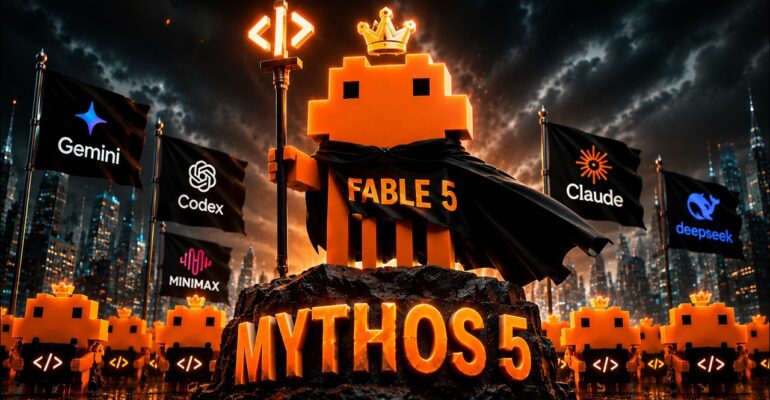
I Tested CloudFable 5: Anthropic’s Secret AI vs 4 Rivals (Real Results)
 admin
admin Last month I made a video about “Sız” — Anthropic’s most powerful model that was completely hidden from the public. Only a handful of tech giants like AWS, Microsoft and Apple had access to it. That changes today. The technology is now officially public as CloudFable 5, and until June 22, everyone can test it for free. In this article, I’ll show you exactly what happened when I ran the same prompts through five different AI systems on my own computer — and why the pricing cliff coming on June 23 matters.
Key Takeaways
- CloudFable 5 is Anthropic’s public release of its previously secret “Mythos” class model, sitting above Opus in capability
- It scored over 80% on software benchmark Bench Pro, well ahead of Opus 4.8
- Built-in safety guardrails automatically downgrade responses to Opus 4.8 for sensitive topics (cybersecurity, biology) in less than 5% of sessions
- API pricing is 2x Opus normally ($10 input, $50 output per million tokens), but free until June 22 on Pro Max and Team Enterprise plans
- In my game-building test, Minimax produced the most playable result; in website building, Gemini delivered the most complete design
- CloudFable 5’s output was polished and organic but surprisingly conservative with images and logos
What CloudFable 5 Actually Is
Let me back up and explain the hierarchy. Anthropic has a model class called “Mythos” that sits above Opus. The top tier of Mythos released in April was so powerful that Anthropic didn’t give it to the public — they only opened it to select enterprise partners under a closed program. That was the model I covered as “Sız.”
CloudFable 5 is the public, safety-hardened version of that same technology. Same underlying power, but with guardrails. Here’s how the safety mechanism works: if you ask something in dangerous territory — advanced cybersecurity exploits, biological engineering instructions, similar high-risk domains — the model refuses and automatically downgrades to Opus 4.8 rather than answering. Anthropic says this triggers in less than 5% of sessions, so for normal coding, content creation, and research, you’ll never hit it.
The developer-facing name is CloudFable 5, accessible through API and Anthropic’s cloud console. The official claim: “this is the most capable model we’ve ever released to the public.” For long, complex tasks, Anthropic says Fable closes the performance gap faster than anything they’ve shipped before.
My Testing Setup: 5 AIs, 2 Prompts, Zero Extra Payment
I wanted real-world results, not benchmark charts. So I built a testing pipeline on my own machine using five different platforms:
- DeepSeek (desktop app, running locally with agents enabled)
- Gemini (via Anti-Gravity interface, using 3.5 Flash at highest setting)
- Codex (OpenAI’s coding model, using Exe-H with GPT-5.5)
- Minimax (M3 model, their top-tier language model)
- CloudFable 5 (direct from Anthropic’s console)
Important note on cost: CloudFable 5 normally runs 5x Opus pricing, but Anthropic is currently charging only 2x while the promotional period runs. I used the free tier valid until June 22.
Prompt one: build a playable browser game from a short description. Prompt two: build a complete website for my business, pulling real information from the internet. Same exact prompts to all five. Here’s what happened.
Test 1: Building a Browser Game
Gemini (Anti-Gravity): Fast but Broken
Gemini finished first — impressively fast. But the result was essentially non-functional. The game rendered something on screen, but movement keys didn’t work. I tried WASD, arrow keys, mouse controls. Nothing responded properly. After a second prompt specifically asking to fix the controls, the character moved but started shooting itself. Playable? Not really. Visually basic.
Codex: Better, But Frustrating
Codex took longer — it was still writing code in the background while others finished. The final result looked more realistic visually. I could shoot, take damage, the game had actual mechanics. But no sound, and I kept getting hit by enemies constantly in ways that felt unfair rather than challenging. I’ve seen much better games come from single prompts. Codex outperformed Gemini significantly, but still felt like a rough prototype.
CloudFable 5: Polished but Conservative
CloudFable 5 produced what I thought was the most visually impressive result — until I tried the controls. Jump worked. Zoom worked (unexpectedly useful for aiming). But mouse look for turning didn’t function. I eventually managed to hit something. The game included respawn timers, a minimap, health tracking, time display. The quality of the polish was clearly above the others. Yet I expected more from a model kept secret this long. It was good, not mind-blowing.
DeepSeek: Complete Failure
DeepSeek didn’t build a functional game at all. It rendered some lights in a browser window and then stopped responding to inputs entirely. After 30 minutes of error loops and background tool calls, it gave up and asked to add the task to a todo list. I eventually redirected it to build a website instead.
Minimax: The Surprise Winner
Minimax M3 delivered the most actually playable game. Movement worked smoothly in all directions. Jump worked. Zoom worked. The game was responsive and functional from the first load. If I had to hand someone a browser game to play immediately, Minimax was the clear choice. Visual polish wasn’t as high as CloudFable 5, but functionality trumped aesthetics here.
Test 2: Building a Business Website
DeepSeek: Fast but Amateur
DeepSeek finished first this time, suggesting it’s more comfortable with structured web content than creative game development. It pulled real information from my site — actual course listings, FAQ content. But the design choices were questionable: random emojis, inconsistent spacing, clearly auto-generated feel. Functional navigation worked, but I wouldn’t show this to customers.
Gemini: The Design Standout
Gemini’s website was genuinely impressive. It generated its own images, created zoom effects, built pricing packages, added testimonials with real review text pulled from my business, and even created a forum section with actual Q&A content. The pricing was wrong, but the sales funnel structure was sophisticated — the kind of format that actually converts visitors. Ultra-futuristic aesthetic, self-contained visuals, no broken elements. If this were a design contest, Gemini won.
Codex: Information-Rich, Visually Weak
Codex pulled comprehensive course information and real testimonials, but the visual execution disappointed me. No generated images, oversized inconsistent text, pop-ups that felt intrusive. Navigation worked, the content structure was thorough, but the theme felt like a template rather than a designed experience. Could be much better.
CloudFable 5: Organic but Underwhelming
Here’s where I need to be honest: CloudFable 5’s website felt like the most natural and organic of the bunch, but it was surprisingly bare. No logo in the header. No images for courses. A “team/community members” section that was referenced but not populated. The structure was clean and orderly, the layout professional, but for a model held back from public release for safety reasons, I expected something more visually complete. Gemini generated images unprompted; CloudFable 5 didn’t even fill obvious placeholders.
Minimax: Solid Second Place
Minimax produced a competent website, though not as strong as its game performance. Functional, reasonably structured, but not visually striking. In my personal ranking for website generation: Gemini first, then a gap, then Minimax and CloudFable 5 competing for different reasons (design completeness vs. structural cleanliness).
The Critical Pricing Window: Before June 22 vs. After
Here’s what nobody should miss. CloudFable 5’s normal API pricing is steep: $10 per million input tokens, $50 per million output tokens — double Opus rates. But from now until June 22, Anthropic is including it at no extra charge on Pro Max and Team Enterprise plans.
On June 23, that changes. You’ll need usage credits at full price. I have two weeks of free testing left, then the cost reality hits. If you’re evaluating whether this model fits your workflow, test now while the barrier is zero.
What CloudFable 5 Won’t Do (And Why That Matters)
I want to be clear about limitations because I see too much AI coverage that glosses over them. CloudFable 5 deliberately refuses certain categories of requests. Ask about advanced cybersecurity exploitation, biological synthesis, similar high-risk domains, and you won’t get a censored warning — you’ll get an automatic downgrade to Opus 4.8’s capability level for that specific exchange.
Anthropic says this triggers in under 5% of sessions, and for normal coding, content work, analysis, and research, you’ll never encounter it. But if your use case touches those edges — penetration testing documentation, certain research applications — you need to know the guardrail exists and how it behaves.
FAQ
Is CloudFable 5 really free until June 22?
Yes, for Pro Max and Team Enterprise subscribers on Anthropic’s platform. After June 23, it requires usage credits at full API pricing ($10/$50 per million tokens).
How does CloudFable 5 compare to GPT-5.5 or Gemini 3.5 Flash?
In my testing, CloudFable 5 produced more polished structural outputs but was more conservative with self-generated visuals. Gemini 3.5 Flash delivered more complete designs with images and effects unprompted. GPT-5.5 (via Codex) was thorough with information but weaker on visual execution. Results vary heavily by task type.
What happens when the safety guardrails trigger?
The model automatically downgrades to Opus 4.8 capability for that specific exchange rather than refusing outright. Anthropic states this occurs in less than 5% of sessions and is designed to maintain helpfulness while reducing risk for sensitive topics.
Should I switch from Opus to CloudFable 5 for my projects?
Test both during the free period. For long, complex reasoning tasks, CloudFable 5 shows measurable improvement. For routine coding or content tasks, the difference may not justify 2x pricing depending on your budget and quality requirements.
Bottom Line
CloudFable 5 represents a genuine capability step forward from Anthropic, but my testing revealed a nuanced picture. It’s not uniformly superior to every competitor on every task. Minimax beat it on playable game functionality. Gemini beat it on self-contained website design with generated assets. Where CloudFable 5 excelled was structural polish, logical organization, and what I’d call “professional finish” — the underlying quality of how information is arranged and presented.
The free testing window until June 22 is genuinely valuable. I’d recommend anyone building with AI tools spend this week running your actual use cases through it, comparing head-to-head with your current stack. The pricing after June 23 is significant enough that you want real performance data, not marketing claims, before deciding where it fits in your workflow.
What would you build with two weeks of free access to Anthropic’s most powerful public model? I’m genuinely curious — the comment section is open.
Watch the full video (in Turkish — English subtitles available):
Tools & Community
- TurkoLister — the AI listing tool I use to turn Amazon products into optimized eBay UK listings in about 60 seconds (from £4.99/month, £1 one-week trial).
- AI & E-commerce Community — my Turkish-speaking community ($19/month) with weekly live sessions.
- Subscribe on YouTube — new experiments every week.
Free guide + training
Enjoying this guide? Get the free AI Automation Playbook
Join readers receiving one practical AI & online-business playbook from our sister academy Okyanusi — the team behind Digital Market Mentoring. Free PDF, instant access after email confirmation.
Want the full step-by-step training? Explore Okyanusi courses →